Internet of Things (IoT)
What it is and why it matters
The Internet of Things (IoT) refers to a vast number of “things” that are connected to the internet so they can share data with other "things" – machines, vehicles, equipment, wearables and more. These networks of physical objects use embedded IoT sensors and internet connectivity to collect and exchange data about performance, location, environment and behavior. In some cases, they can act on the information they receive. Examples range from smart home devices that automatically adjust heating and lighting to smart factories that monitor industrial machines for quality issues.
History of the Internet of Things
The phrase “Internet of Things” was introduced in 1999 by Kevin Ashton, co-founder of the Auto-ID Center at MIT. He used the term during a presentation to Procter & Gamble, where he demonstrated how RFID tags could link objects to the internet and improve visibility across their supply chain.
Even then, the concept of connected devices (particularly connected machines) wasn't new. Machines had been communicating for more than a century, since electric telegraphs in the late 1830s began sending machine-to-machine signals. Radio transmission, SCADA systems and early networking technologies followed. And in 1982, a Coke machine at Carnegie Mellon University became one of the first internet-connected smart appliances when students installed micro-switches to monitor inventory and temperature. Using the university’s local Ethernet (ARPANET), they could check the status of the machine's drinks by typing “finger coke@cmua.”
Ashton later recalled that early critics doubted IoT would ever scale. They warned that data volumes would overwhelm the internet. Some said the necessary radio communications weren’t physically possible, or that silicon chips were either too costly or not sufficiently available to support billions of devices. Some even insisted the internet itself was a fad.
History proved the skeptics wrong. Sensors became smaller and cheaper. Wireless connectivity is nearly ubiquitous. Cloud computing now provides scalable storage and processing. And streaming analytics enables real-time decision-making when data is generated. In the age of Industry 4.0, billions of connected sensors quietly power the digital systems that run our factories, cities, hospitals and homes. In fact, there are more than 21 billion IoT devices in use globally.
Event stream processing in manufacturing
Georgia-Pacific, one of the world's largest building materials manufacturers, considers success a matter of both output and foresight. But it had become difficult to make real-time interpretations of millions of data points streaming from hundreds of thousands of sensors across the organization. Now, using more than 30,000 machine learning models and real-time data, the company can calculate optimal production settings, balance speed and quality, and intervene early to avoid downtime if models predict process anomalies. Using SAS with sophisticated computer vision algorithms has also improved employee safety.

The Internet of Things in today’s world
The Internet of Things, once dismissed as impossible, now underpins global commerce – and the next wave of innovation is still accelerating. Learn how IoT is affecting our lives today as the volume and variety of big data streaming from IoT expands and analytics technologies evolve.
Which industries use IoT?
Many industries use IoT to understand consumer needs in real time, become more responsive, improve machine and system quality on the fly, streamline operations and discover innovative ways to operate as part of their digital transformation efforts.
How the Internet of Things works
The Internet of Things works by sensing, transmitting, analyzing and acting – continuously and at scale. Embedded sensors capture signals from the physical world. Networks move that data across edge devices and cloud platforms. Streaming analytics and artificial intelligence interpret what’s happening in real time. And automated systems trigger alerts, workflows or decisions.
Since 2012, major changes in sensors led to rapid maturing in the Internet of Things market – fueling digital transformation for many businesses:
- Sensors shrank. Technological improvements created microscopic scale sensors, leading to technologies like microelectromechanical systems (MEMS). This made sensors small enough to be embedded into unique places like clothing.
- Communications improved. Today, nearly every type of electronic equipment can provide wireless data connectivity. This allows IoT sensors embedded in Internet of Things connected devices and machines to quickly send and receive IoT data over a network.
Why is IoT important?
IoT systems generate enormous volumes of streaming data. The value comes from understanding events while they’re happening, so the data must be analyzed in motion – before it ever reaches long-term storage.
Three major shifts define modern IoT:
- From “store then analyze” to “analyze in motion.” Traditional systems streamed data, stored it and analyzed it later. Modern IoT uses a “stream, score, then store” approach – analyzing events as they occur and storing only what matters. This reduces latency, bandwidth use and cost.
- From centralized processing to edge intelligence. Edge computing pushes analytics closer to data origination. Processing data at the edge reduces latency and network dependency, improves resiliency and increases security by limiting data transmission. In high-stakes environments, like predictive maintenance or quality control, milliseconds matter.
- From data visibility to automated action. AI embedded within IoT platforms enables automated responses. Neural networks, regression models, computer vision and classification techniques can operate at the edge or in the cloud, triggering alerts or automatically initiating workflows. IoT shifts from purely observational to operational.
IoT turns isolated data points into coordinated action and transforms operational guesswork into evidence-based decision-making. When IoT data is analyzed in motion and paired with AI, the benefits become measurable, including: reduced downtime, improved product quality, lower operating costs, enhanced safety, greater supply chain transparency, increased resiliency and better customer experiences.
How does IoT work with other technologies?
Data management and streaming analytics
IoT data doesn’t arrive in tidy batches; it flows continuously. All this big data flowing from sensors requires intense data management via streaming analytics – known as the control layer. Event stream processing technologies (or streaming analytics platforms) perform real-time data management and analytics on IoT data to make it more valuable. They filter, normalize, standardize, transform, aggregate and correlate events in real time – turning raw signals into structured insights before delays or bottlenecks occur.
Big data analytics
IoT is a major contributor to big data – the massive volume, velocity and variety of structured and unstructured data businesses collect every day. Getting value from big data in IoT requires big data analytics. Related techniques include predictive analytics, text mining, cloud computing, data lakes and data mining. Most organizations use a combination of these techniques to maximize value from IoT.
Artificial intelligence
Artificial intelligence – the intelligence layer – uses data from multiple smart connected devices to promote learning and collective intelligence. Machine learning models detect patterns in high-velocity data streams. Computer vision processes video and still images in real time. Text analytics and anomaly detection surface emerging risks or opportunities before humans would recognize them. Together, streaming analytics and AI allow IoT systems not just to report what happened – but to decide what should happen next. This convergence is often called the “artificial intelligence of things.”
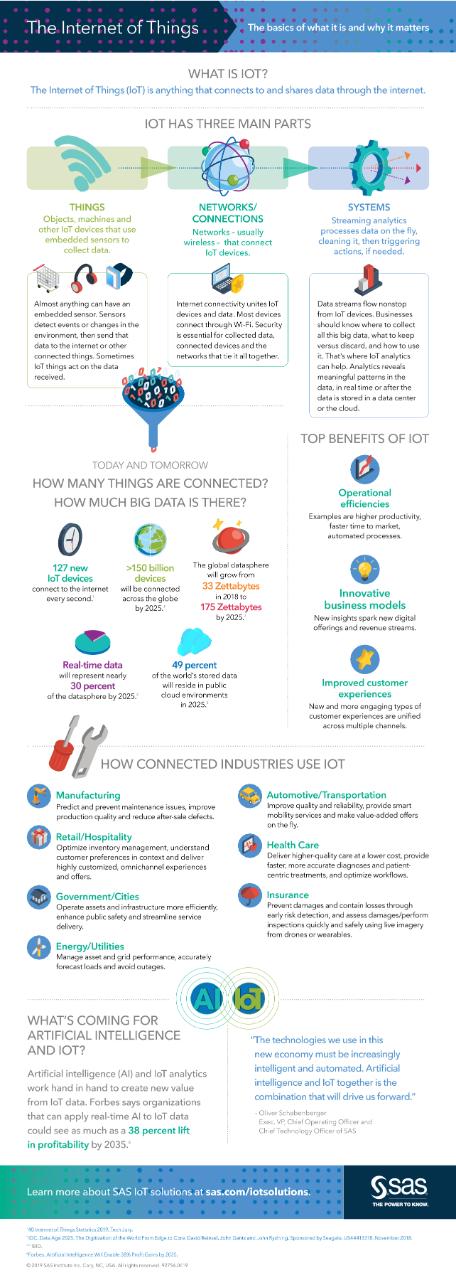
Click on the infographic to learn more
The future of the Internet of Things
IoT has expanded beyond connected devices into connected ecosystems. Real-time digital twins mirror factories, cities and supply chains, using live sensor data to simulate outcomes before decisions are made. Satellite-enabled IoT extends connectivity to oceans, remote farms and disaster zones, while smart infrastructure increasingly monitors itself – and in some cases adapts.
The future isn’t just more data. It’s more autonomy.
Systems will increasingly detect anomalies, optimize performance and initiate decisions without human intervention – across factories, hospitals, transportation networks and smart cities.
The Internet of Things began as a way to connect things. It is becoming a way for systems to sense, decide and act – shaping a more responsive, efficient and intelligent world.
Digital twins and IoT at work in factories
When they need to improve business processes, organizations can use digital twins with IoT data, analytics and AI. With these technologies, manufacturers (for example) can create realistic simulations to capture information that helps fine-tune their operations. To make it happen, they mirror every device, machine and IoT sensor on the factory floor, then analyze the data to visualize where optimizations are needed. See how SAS and Epic Games have collaborated to make it real.
SAS® Event Stream Processing
From the moment IoT sensors generate data to the point decisions are triggered, SAS Event Stream Processing enables real-time intelligence at the edge and in the cloud. Deploy scalable streaming analytics environments, integrate open source models and apply AI techniques across multiple event phases.

Recommended reading
-
 Article
Big data in government: How data and analytics power public programsBig data in government is vital when analyzed and used to improve the outcomes of both public and private sector programs – from emergency response to workforce effectiveness. The vast volumes of data created every day are the foundation of insightful changes for government agencies across the globe.
Article
Big data in government: How data and analytics power public programsBig data in government is vital when analyzed and used to improve the outcomes of both public and private sector programs – from emergency response to workforce effectiveness. The vast volumes of data created every day are the foundation of insightful changes for government agencies across the globe.
-
 Article
5 IoT applications retailers are using today The Internet of Things can bring big benefits, but what is IoT and how are retailers taking advantage of it?
Article
5 IoT applications retailers are using today The Internet of Things can bring big benefits, but what is IoT and how are retailers taking advantage of it?
-
 Series
Meet the data scientist: Daymond LingDaymond Ling believes the right personal traits are more important than technical skills when it comes to being a successful data scientist.
Series
Meet the data scientist: Daymond LingDaymond Ling believes the right personal traits are more important than technical skills when it comes to being a successful data scientist.